Friday, February 19, 2016
Young dolphin dies when it's carried on the beach for people to stroke and take selfies with
Climate: Lobster Shell Disease, Sea Star Epidemic Caused By Warming Waters, Cornell Researchers Confirm
Lobsters in some areas of North America have experienced since the 1990s something called "epizootic shell disease," which makes their shells unsightly and difficult to sell. The condition has devastated lobster fisheries in southern New England, and now the Maine lobster industry may be at risk, too. A new Cornell University study conducted in 2015 suggests that warming ocean temperatures are largely responsible for this epidemic.
Researchers See Link Between Zika & Global Warming
Monday, February 1, 2016
New Satellite Collects Sea Level Data to Monitor Climate Change
Report finds whales and dolphins unable to breed due to pollutants
Shannon dolphins and Cork killer whale biopsies contributed to international study
Tuesday, July 15, 2014
'Sea monster's' skeletal remains discovered on West beach | Western Morning News
A family were left baffled after discovering this weird "sea monster" washed up on a local beach.
Lisa Worthington, 42, came across the denizen of the deep while out walking the family dog with husband, Peter, 52, and their two children.
The two-foot long skeletal remains were found on the high tide mark on the beach in Weston-Super-Mare, North Somerset.
The family decided to take the mysterious two foot skeleton home so that her ten-year-old son Tyler could show his friends.
Lisa, from Uphill, near Bristol, said: "It was really quite strange. We were just walking the dogs when we stumbled across it. It was very strange.
"People have come up with some crazy ideas as to what it could be. My friend even thought it could be a llama, as the long tail-y bit looks like a neck.
"I guess with it being washed up on the beach you would expect it to be a fish or something, but it doesn't look very fishy.
"My son was fascinated by it. I've definitely not seen anything like it before. He wanted to take it to school for show and tell.
"He carried it home in a big carrier bag. It absolutely stinks now though. I've told him he's going to have to get rid of it."
The family posted an image of the skeleton on Facebook where speculation grew about what the creature could be.
Some suggested the animal was a lizard or swan whilst others claimed it was some kind of large fish or stingray.
Marine biologist Steve Simpson, said: "This is certainly nothing I have seen before."
Other deep sea creature experts said that it was likely the skeleton was that of a thornback ray.
Shelby Temple, a professor a Bristol University, said: "I think that is the remains of a thornback ray (Raja clavata).
"They are fairly common on muddy/sandy substrates around the UK and Europe.
"The photos certainly make it look like a weird deep sea creature. You wouldn't want to inadvertently step on that tail!"
Read more at http://www.westernmorningnews.co.uk/Sea-monster-s-skeletal-remain-discovered-West/story-21460966-detail/story.html#yTvAuuKIIQKfDYgw.99
Tuesday, June 24, 2014
Global Warming is about to Decimate the Building Blocks of Life in the Ocean
Researchers warn that marine life could be dramatically affected as climate change threatens to cause severe reduction of plankton – the key source of nutrients − in some ocean regions by the end of the century
LONDON, 12 May − There are plenty more fish in the sea − but not for too much longer in some parts of the world, researchers say. And the reason is very simple: the food on which they all depend faces a marked decline.
Researchers from AZTI-Tecnalia, a Spanish-based technology centre specialising in marine and food research, report in the journal Global Change Biology that the warming of the oceans will cause phytoplankton biomass to decrease by 6% by the end of this century.
Phytoplankton are the single-celled plants that are the basic building blocks of most marine life. In particular, they sustain zooplankton − tiny animals that are eaten in turn by fish. The study found evidence that, by 2100, zooplankton biomass will be 11% less than it is today, with obvious implications for the fish that feed on them.
The report says that sea surface temperature is predicted to increase by 3.4ºF on average globally by 2080-2100. The consequences of this increase will include changes in ocean circulation and higher water column stratification, where water of different densities forms distinct layers instead of mixing, affecting the availability of nutrients.
Biomass reduction
The depletion expected in the amount of plankton in the marine food web could reduce fish biomass in 47% of the total global ocean area, especially in tropical oceans.
But phytoplankton and zooplankton reduction will affect different regions in different ways. In the North Sea and temperate north-east Atlantic, higher stratification and lower nutrient levels will reduce phytoplankton growth. In the Baltic, Barents and Black Seas, it is expected to increase.
Guillem Chust, an Azti-Tecnalia researcher and the lead author of the paper, said: “In the ocean regions that lose more phytoplankton and zooplankton biomass, fish biomass may also decrease dramatically.” He said this would especially affect pelagic species − deep-sea fish that are not bottom dwellers.
He said the oceans’ role in moderating climate change would also be damaged: “As there will be less phytoplankton, absorption of CO2 from the atmosphere by the oceans will be lower, as plankton is responsible for half of the planet’s photosynthetic activity. This in turn will reduce the ocean’s capacity to regulate the climate.”
The research was undertaken as part of Marine Ecosystem Evolution in a Changing Environment (MEECE), a European Union project to explore the impact of climate and human activities on marine ecosystems.
One of the project’s concerns is the growing evidence of damage from ocean acidification, the process by which emissions of carbon dioxide are making the seas increasingly acid and hostile to some forms of marine life.
Emission limits
A group which works to protect seafood supplies and marine ecosystems, Global Ocean Health, has welcomed a move by the US Environmental Protection Agency intended to lead to the introduction of performance-based emission limits for new power plants, which would help to reduce the threat of acidification.
“The rule would help protect productive fisheries and oceans,” GOH says. “Although it cannot single-handedly staunch the flow of carbon emissions that drive ocean acidification, the rule would make a good start.”
Capping CO2 emissions per unit of power produced would, GOH says, effectively block any new coal plants in the US, ensuring a continued shift towards natural gas, which is cheaper than coal. In the last six months, it says, more than 80% of the new electricity capacity added to the US grid was renewable energy.
It also believes the rule would dampen global investors’ appetite for coal projects by demonstrating that the US is no longer willing to tolerate unlimited CO2 emissions from coal.
“With this policy, the world’s most influential economic superpower would signal to global capital markets that coal is no longer a safe investment,” GOH says.
This would add to the growing argument that fossil fuel reserves risk becoming unusable “frozen assets” because of their climate impact. − Climate News Network
Mirrored from the Climate News Network
Monday, April 12, 2010
Oil: From the offshore to onshore, From the deep sea to coral reefs
Last Wednesday, Obama in a very surprising move, unveiled plans for large swaths of the ocean off the East Coast, eastern Gulf of Mexico, and Alaska to be drilled for oil and gas for the first time. Specifically the plan allows areas from Delaware to central Floria, the Chukchi and Beaufort Seas, and swath 125 miles off Florida's coast currently under congressional moratorium, to be opened up to industry. As a first step, the Obama plan authorizes the Interior Department to start conducting seismic studies to locate potential seafloor deposits.
Why?
Obama stated, "The bottom line is this: Given our energy needs, in order to sustain economic growth and produce jobs and keep our businesses competitive, we are going to need to harness traditional sources of fuel even as we ramp up production of new sources of renewable, homegrown energy." Obama addressed those who will "strongly disagree" with this decision by saying the announcement is part of a broader strategy to move from an economy run on fossil fuel and foreign oil to one that relies on domestic fuels and clean energy. "The only way this transition will succeed is if it strengthens our economy in the short term and long run," he said. "To fail to recognize this reality would be a mistake."
So is the the appropriate move forward? Some believe this was Obama's move to gain further support for a later comprehensive climate and energy bill, i.e. a political opposed to an energy move. And indeed the strange union of liberal Democrat Barbara Block of California, whose state was spared, and Exxon both heralding Obama's policy is so strange my laptop is at risk of bursting into flames as I type this.
But what would appear to be a concession to Republicans has only angered some of them.
Rep. Mike Pence of Indiana, chairman of the House Republican Conference, called the announcement a "smokescreen." "As usual, the devil is in the details," Pence said. "Only in Washington, D.C., can you ban more areas to oil and gas exploration than you open up, delay the date of your new leases, and claim you're going to increase production." House Natural Resources Committee ranking member Doc Hastings (R-Wash.) said the administration "is attempting to pull the wool over our eyes." "President Obama's rhetoric conveys support for increasing American oil and natural gas production, while the reality is he's proposing a plan that will close more areas to drilling than it opens, and the few areas still available won't be open for years," Hastings said.
As can be imagined conservation groups are also angered and not just the ones you might expect, e.g. Greenpeace. Oceana, an organization who in my opinion typically proceeds strategically, thoughtfully, and cautiously, is leading a letter campaign stating
Expanding offshore drilling increases threats to marine habitats and creatures and does nothing to curb harmful carbon emissions; in fact, it increases pollutants in our atmosphere and oceans. Including offshore drilling in climate change legislation is not only a political compromise – it is compromising the future health of our oceans. Help us reach our goal of 25,000 ocean activists to speak up against offshore drilling.
And, well frankly I can't agree more.
First, I think the move is politically naive. The behavior of Republicans during healthcare reform is all you need to consider. This is the group that voted no to everything in healthcare reform, even as parts were borrowed from R-Mitt Romney's state insurance plan for Massachusetts. This is the group that stated they would continue to vote no on everything the Democrats proposed. Republicans would vote no on a bill stating they were Republicans if the Democrats proposed it. Republicans have no interest in bipartisan progression. Is opening vast swaths of the oceans worth a few Republican votes that Obama doesn't even need? What if it leads to a loss of Democratic votes.
Second, I think the move is environmentally naive. It does nothing more than continue our reliance on fossil fuels, perpetuating a cycle of behavior that will ultimately warm, acidify, and pollute our oceans. At local scales, drilling impacts will greatly threaten the life of the seafloor. And that oil won't only being going into our big SUV's to hold our fat American assess, it will end up on our protected marine habitats. Or maybe Chineses asses and Australian reefs
A Chinese-registered ship carrying coal that ran aground off the coast of northeast Australia was leaking oil Sunday near the Great Barrier Reef — the world's largest coral reef system. The ship, called Shen Neng 1, was carrying about 65,000 tons of coal to China from the port of Gladstone when it ran aground at about 5:10 p.m. Saturday, according to a Queensland state government statement. The vessel was carrying about 950 tons of oil on board and was leaking into the surrounding waters early Sunday, according to the statement. Maritime Safety Queensland has responded to the scene to assess the spill and plan a clean-up. A light aircraft was expected to spray a chemical solution on the oil.
Third, I am not even sure it makes sense economically.
One reason they haven't is that offshore drilling requires an investment of hundreds of millions of dollars just to find a productive site. Once oil is discovered, offshore rigs used to bring it to the surface cost $1 billion or more. And years would pass before those new rigs could produce their first barrel of oil. Meanwhile, under Obama's proposal, East Coast states and parts of Alaska would expose valuable shoreline and beach property to the possibility of a disastrous oil spill. Tourism benefits coastal states a lot more than skimpy oil royalties would. Why do you think California opted out of this deal right from the start? America also would be wasting time and money that should be spent on developing alternative energy sources, such as wind, solar, cleaner alternative fuels and, yes, nuclear power. While we fiddle, China solidifies its stature as the green energy innovator of the world.
All this leaves me to believe the Republican party and Exxon have kidnapped Obama and put Sarah Palin in an Obama suit. And as James Werrell writes, "But while "drill, baby, drill" makes a cute catch-phrase, it's still a dumb idea, no matter who proposes it.
"
Research helping redraw Hawaii’s tsunamis threat maps | honoluluadvertiser.com | The Honolulu Advertiser - 使用 Google 工具栏发送
Hundreds of homes and businesses in areas long believed to be safe from a tsunami could be added to O'ahu's evacuation map in light of new research.
Even as up to 50,000 people statewide evacuated during the Feb. 27 tsunami warning, work was already well under way to upgrade Hawai'i evacuation maps, which are nearly two decades old.
The good news is that the maps created in 1991 are still largely accurate, and inundation zones will mostly remain the same.
However, an examination of the five most dangerous tsunamis that struck the Islands in the last 100 years has found that the threat in some areas may be greater than originally believed.
The result could be expanded evacuation zones in areas including Waialua and Hale'iwa, around Kāne'ohe Bay and along O'ahu's South Shore. Other areas could see evacuation zones shrink.
"I hate broad-brush generalities, but in general I think on the south coast of O'ahu, we're going to need to evacuate more people," said Peter Hirai, deputy director for the city Department of Emergency Management.
Currently, no evacuation is called for around Kāne'ohe Bay.
"We always said if you live around Kāne'ohe Bay, so long as you're more than four feet away from the edge of the water, you're OK," Hirai said. "That's changed."
The new tsunami research, conducted by Kwok Fai Cheung, a University of Hawai'i professor, makes recommendations, but it's up to counties to decide whether to expand or shrink evacuation zones.
O'ahu has already received its updated inundation zones and is considering map changes this month with plans to present them to the community for input once the maps are completed.
Hirai and other officials declined to release specifics about the areas affected because they are still in the process of deciding what changes, if any, to make.
learning from 2004
The project was prompted by the Sumatra-Andaman earthquake of December 2004, which produced a killer tsunami in the Indian Ocean that swept across a dozen countries and killed hundreds of thousands.
The state Legislature in 2005 alloted $2 million a year for two years to state Civil Defense to improve its emergency shelter program, modernize its siren warning system and update the inundation zones, said Ed Teixeira, vice director of state Civil Defense.
The National Tsunami Hazard Mitigation Program has kicked in about $300,000 so far and is expected to continue funding the project with about $200,000 a year.
FEMA and the Army Corps of Engineers provided topographical information with a LiDAR (Light Detection And Ranging) survey at a cost of about $700,000 to the state, Teixeira said.
Yoshiki Yamazaki, one of Cheung's graduate students, developed the NEOWAVE model for the project, for which he won an award.
The end product is a computer model that uses the LiDAR survey and data collected after the major tsunamis of 1946, 1952, 1957, 1960 and 1964 to create the new inundation zones. The data includes runup, or how high above sea level a wave gets, and inundation, or how far inland it travels.
Cheung was required to take the Sumatra-Andaman quake of 2004, double it and place it at sites around the Pacific, then run the model to see what it would do to Hawai'i, Teixeira said.
"Our tsunami maps now from the 1991 era still hold up with some exceptions," he said, adding that the Hilo zone may change. "Where Hilo has a very generous evacuation zone (Cheung) is recommending not going so far."
revising the maps
Other areas the city will have to look at are Hale'iwa, Waialua and the area around the Dillingham airfield, which traps water, Teixeira said. Honolulu Harbor near Iwilei, and the area mauka of Kalaniana'ole Highway may need some attention as well, he said.
The original maps of 1991 were prompted by an all-out evacuation in 1986 that caused gridlock on shorelines when the wave struck. Fortunately, it was a small tsunami that caused no damage.
"That was a big screw up by the state and the county," said George Curtis, who created the 1991 maps and is the tsunami adviser for the Big Island. "They sent everybody home and it had nothing to do with whether you were near the shore or not. They closed Ala Moana shopping center, and it's perfectly safe."
Recognizing that good maps would reduce the problem, Curtis lobbied the Legislature for money and developed the maximum expectable inundation from probable tsunami directions, he said. Those maps were designed by county civil defense agencies, he said.
With as little as three hours to evacuate threatened areas, the agencies must decide who will evacuate, keeping in mind the 1986 gridlock, Curtis said.
While Curtis, who is a consultant for the new project, was pleased that the maps created by his old one-dimensional model are still valid, he said this new model is more accurate.
"It's much better modeling and the thing that's much improved about it is their topographic data," Curtis said. "It's a 2-D model, compared to a one dimensional so it's a far better model and that's something to emphasize."
The Associated Press: Chile quake offers tough lessons for US coast
By BRAD HAYNES (AP) – 5 days ago
SANTIAGO, Chile — As the Easter earthquake shook Southern California, the state's disaster management chief was thousands of miles away in Chile, examining what experts say is the best case study yet for how a truly catastrophic earthquake could impact the United States.
Chile and the U.S. Pacific coast have more in common than their geology; they share advanced construction codes, bustling coastal cities, modern skyscrapers and veteran emergency services.
These were all put to the test in Chile, which despite its extensive planning lost 432 lives in the 8.8-magnitude earthquake and resulting tsunami — lessons that California, Oregon and Washington have yet to fully learn despite deep experience with lesser quakes.
They include: Coastal flood maps mean nothing without local enforcement. Hospitals need to not only stay upright but also stay open. Stringent building standards require stringent inspections. And tourists need to be taught about the dangers of tsunamis, which caused the greatest loss of life in Chile, wiping out seaside campgrounds on the last weekend of summer vacation.
"People living there know that when the earth shakes, it's like an alarm going off: Get out. But visitors aren't conditioned like that," said Matthew Bettenhausen, the secretary of California's Emergency Management Agency.
Most of Chile's modern buildings emerged with little more than broken plaster, but there were some spectacular failures among recently built structures. Some experts blame code violations that lax inspections failed to catch.
"It's not enough to have a good law — you have to follow it," says Rodolfo Saragoni, the University of Chile's top seismic engineer.
Chileans who lost their homes are asking how building firms got away with cutting corners.
"I've never made walls this thin for this kind of building," said civil engineer Carolina Astorga, showing the AP the damaged foundations of her 19-story apartment building in Santiago.
She moved in a month before the quake. Now the building is sunken, leaning and uninhabitable.
"They save more rebar, more money and it comes out cheaper for the contractor. But here are the consequences."
Code enforcement in California, as in Chile, falls to local governments. Some are sticklers, but others are essentially "paper building departments, where they're pushing paper but not actually rigorously enforcing building codes," said Fred Turner, a structural engineer with the state's Seismic Safety Commission.
"I'm afraid there are a few jurisdictions in California that are probably not much better," Turner added.
Likewise, the tsunami responsible for most of Chile's death toll was perfectly predictable from official flood maps published on the navy's Web site. But the coastal cities devastated by the waves did nothing to incorporate the charts in public planning.
"At the least, it indicates a profound lack of coordination between institutions," said Hugo Romero, a geographer at the University of Chile. At worst, he said, it may reflect commercial interests overwhelming the public interest.
Chile's landscape is similar to built-up stretches of the California coast, where state and federal officials have worked to make flood maps available, but local authorities don't always pay heed.
Some California cities — Long Beach, Crescent City and Santa Barbara among them — now incorporate tsunami risks in their public planning. "Other jurisdictions just haven't gotten around to doing anything yet," Turner said.
"California is catching up," he added, noting that Oregon and Washington have a fraction of the population exposure along the coast, but have done more to prepare for the next tsunami.
In other respects, the Pacific Northwest is at risk.
Scientists say a nearby coastal fault like Chile's will likely slip within a few decades, releasing a similarly devastating mega-quake. A magnitude-9 quake struck the area in 1700.
Washington's building codes were updated to international seismic standards in recent years, but Chile has shown that great standards on paper do nothing when a city is full of older buildings that were grandfathered in.
University of California at Berkeley's Jack Moehle, who led a team of engineers assessing Chile's damage, takes that lesson from two cities near the epicenter: Chillan was almost entirely rebuilt with stronger buildings after a 1939 quake, and survived this one more or less OK. Nearby Talca was full of earlier architecture — and devastated.
"To see Chillan versus Talca, it's like day and night," he said.
California's older cities would suffer more like Talca did if a major quake struck them today, Moehle warns.
Hospitals and other key buildings in parts of California could fare even worse than those in Chile, said structural engineer Bill Holmes, who has been examining Chile's hospitals. Many had 72 hours worth of gas and water on site, which proved invaluable in the catastrophe's aftermath.
California's hospitals are not expected to meet that standard until 2030. And one in 10 won't even be safe from collapse by 2015, according to a report prepared for the California Senate's Health Committee in February.
The rare intensity of Chile's earthquake is also teaching engineers about how international seismic standards might be improved.
Chile's temblor included an unexpected amount of vertical shaking in addition to the usual horizontal movement, according to structural engineer Jay Guin, who runs risk modeling for Applied Insurance Research Worldwide.
Both Chile and the U.S. may need to update building codes accordingly — perhaps applying tougher standards to shakier ground, like the volcanic ash under Concepcion or the landfill under parts of San Francisco.
"It acts like Jell-O. You get that extra violent shaking," said Bettenhausen.
Climate change already killing 150,000 a year in low-income economies: WHO
Climate change has begun to affect human health, leading to a rise in cases related to stomach ailments and vector-borne diseases like malaria and dengue. This has been indicated in a report in the recent bulletin of the World Health Organisation (WHO).
The apex global health body reckons that about 150,000 deaths occur annually in low-income countries due to the adverse effects of climate change, chiefly malnutrition due to climate change-driven crop failures, stomach diseases and malaria.
The report says that the rise in atmospheric temperature and sea levels, coupled with extreme weather events, notably higher frequency of floods, cause water logging and water contamination, leading to higher incidence of diarrhoeal ailments. The geographical spread of vector-borne diseases such as malaria and dengue is also projected to increase.
Besides, the dynamics of communicable diseases may undergo a change, WHO has cautioned. The poorer countries will be affected relatively more because of their deficient health systems and paucity of resources.
Higher average temperatures as a consequence of global warming could prolong peak periods for vector-communicated diseases. Besides, extreme weather events, including cyclones and floods, can create conditions ideal for the spread of several diseases, including diarrhoea and cholera, the report states. Dengue epidemics are already occurring more frequently and are now reported even from hilly countries like Bhutan and Nepal.
The report notes that most countries in the Southeast Asian region, home to 26 per cent of the world's population and 30 per cent of the world's poor, lack sufficient plans for disease and vector surveillance and control. They also do not have adequate health systems in place to serve as barriers against the adverse effects of climate change on human health.
The UN Inter-governmental Panel on Climate Change has already warned that parts of Asia are likely to experience serious adverse effects of climate change because the economies of most countries in this region rely on agriculture and natural resources. People living in vulnerable, yet densely populated, areas are usually disproportionately affected by the consequences, as has been shown by the impact of the devastating floods in Bihar in 2009.
According to the Asian Development Bank, in countries like Indonesia and Thailand, the want of adequate measures to counter the ill-effects of climate change could result in economic losses of 6-7 per cent of their combined gross domestic product by 2100, compared to a loss of some 2.6 per cent of the world's GDP during this period.
Research is underway in India and Nepal on assessing the impact of climate change on vector-borne and water-borne diseases. It will be extended to other countries in the region, subsequently. Its outcome could guide the development of integrated national and regional plans of action for public health interventions to mitigate the impact of climate change on health.
"If all countries of the region make a combined effort to tackle the effects of climate change on health, the resulting evidence base, emerging best practices and lessons learnt will make a valuable contribution to global health," the report says.
Monday, August 10, 2009
NOAA and partners to survey marine life at USS Monitor wreck site
NOAA will participate in a private research expedition to study marine life living on and around the wreck of the USS Monitor. The August 2-8 expedition is the first in the history of Monitor National Marine Sanctuary devoted specifically to understanding how the wreck contributes to the health of underwater creatures and plants living in sanctuary waters.
Using non-invasive techniques, divers will conduct an inventory of various species of fish, crustaceans, mollusks, jellyfish, corals, and sponges. The survey also will examine the population of lionfish on the wreck to determine if this fierce predator is harming the site's natural ecosystem.
"The information collected during this expedition will help us to better understand the role the historic shipwreck has played as an artificial reef and may be important to our efforts to continue preservation of the USS Monitor," said David W. Alberg, superintendent of USS Monitor National Marine Sanctuary.
The biological research will be conducted by dive teams from the North Carolina Aquarium on Roanoke Island, the Outer Banks Dive Center, Ocean Explorer Charters, and Associated Design. The data collected will be analyzed by the Smithsonian Institution's Marine Botany Department.
"It is vital that we can better understand the wreck as a reef as we move forward in determining how best to manage the Monitor sanctuary," said Jeff Johnston, historian for Monitor National Marine Sanctuary. "The collaboration of private citizens and a state and federal agency working together to gain a better understanding of one of America's most significant ships is a great story in itself."
The USS Monitor is located in 240 feet of water 16 miles south of Cape Hatteras, North Carolina, where the ship sank on a stormy New Year's Eve in 1862. In an effort to protect the nation's most famous ironclad, the shipwreck was designated Monitor National Marine Sanctuary in January 1975. In the late 1990's through 2002, several iconic Monitor artifacts were recovered and are being conserved at The Mariners' Museum in Newport News, Va.
NOAA understands and predicts changes in the Earth's environment, from the depths of the ocean to the surface of the sun, and conserves and manages our coastal and marine resources. Visit http://www.noaa.gov.
Tuesday, March 31, 2009
Indian Ocean island votes to become fully French
PARIS (Reuters) - Voters on Mayotte, a tiny island in the Indian Ocean, chose by referendum Sunday to become a fully fledged part of France -- a change of status that will end local traditions such as polygamy and Islamic courts.
Authorities said 95.2 percent of those who voted opted to turn Mayotte into a "departement," strengthening ties with Paris and requiring the island to align itself with French law. Only 4.8 percent voted no. Participation was 61 percent.
Mayotte, 400 km (250 miles) east of Mozambique and 300 km west of Madagascar, is in the Comoros archipelago but voted against independence in referendums in 1974 and 1976.
Instead it stayed French, with a status allowing legal differences from the mainland.
It has a population of about 186,000 people, of whom 95 percent are Sunni Muslims. Many do not speak French and a third of the population are illegal migrants, mostly from the nearby islands which make up the independent Comoran state.
"This will reinforce the place of Mayotte in the republic, reaffirming our founding values, particularly equality between men and women, the same justice for all, and the place of the French language," said Interior Minister Michele Alliot-Marie.
Many islanders were keen to boost ties with mainland France, which have kept Mayotte richer and more stable than the Comoros.
"We may be black, poor and Muslim, but we have been French longer than Nice," Abdoulatifou Aly, a legislator from Mayotte, was quoted as saying in the French weekly L'Express.
President Nicolas Sarkozy had promised a referendum during his 2007 campaign. After Sunday's vote, the island is on track to become France's 101st departement in 2011.
The referendum follows unrest in another French overseas departement, the Caribbean island of Guadeloupe, which was rocked by a general strike for pay rises in February and March.
That suggests that becoming a departement will be no panacea for Mayotte, where unemployment runs at more than 25 percent.
The islanders stand to gain economically from the change of status, as they will become eligible for a wider range of social benefits as well as EU funds. Paris has also promised an economic development fund to boost the island's infrastructure.
However, residents will see their tax bills increase and have to abandon certain customs to conform to French law.
For now, men can have several wives whom they can repudiate unilaterally, and women do not have equal inheritance rights. The island has a traditional Islamic justice system with "qadis" or religious scholars who act as judges.
Mayotte will have to ban polygamy, raise the minimum age of marriage to 18 from 15 years old, and give women equal rights.
The Islamic justice system will be replaced by secular courts, though qadis will retain a consultative role.
Hurricanes not likely to disrupt ocean carbon balance
Observations in Bermuda and the Caribbean in the 1990s noted that hurricanes' powerful winds and the resultant water mixing can trigger enhanced carbon dioxide release from the ocean into the air. Large-scale extrapolations of these observations suggested that increasing numbers of hurricanes could significantly alter the overall carbon balance of the ocean and atmosphere.
However, a new study from the University of Wisconsin-Madison indicates that storm-induced carbon release is local and temporary and does not seem to affect the long-term ability of the tropical Atlantic to absorb atmospheric carbon dioxide. The study has been accepted to publish in an upcoming issue of the journal Geophysical Research Letters.
"The suggestion was that an increase in hurricanes might reduce the ocean's effectiveness in being a carbon sink, and therefore enhance global warming," says Galen McKinley, a professor of atmospheric and oceanic sciences and affiliate of the Center for Climatic Research at UW-Madison.
Her new study suggests otherwise.
Some carbon dioxide is naturally released from the ocean each year and the amount varies over space and seasons, McKinley says. With colleagues Jennifer Koch, Val Bennington and David Ullman, she adapted an ocean circulation model to capture this variability and ask whether total carbon release increased in years with high hurricane activity.
When they applied their model across a 15-year time period (1992-2006) and the entire subtropical North Atlantic basin, where most hurricanes develop, they found no relationship between the number of hurricanes and amount of carbon dioxide released in a year.
"There is a large efflux of carbon locally during a hurricane," McKinley explains. "But when we think about that at a large scale and over the entire year, the effect goes away."
The ocean is the single largest carbon sink on the planet, meaning it absorbs and stores more atmospheric carbon long-term than anything else.
"Since the Industrial Revolution, about half of the carbon humans have emitted has gone into the ocean, which has significantly damped global warming to date," says McKinley. "However, now the ocean can only take up about 25 percent of our emissions and this rate appears to be declining, so we need to understand in detail the processes that control the ocean carbon budget."
Based on their modeling results, McKinley believes a potential increase in hurricanes — currently forecasted by many climate scientists — would not have much effect on the ocean's ability to absorb atmospheric carbon. Other factors, such as wind, biological activity, and the total amounts of carbon present in the ocean and air will likely play a larger role in determining the overall carbon balance.
"We still have a lot to learn about how natural climate variations affect things like the ocean's uptake of carbon," McKinley says. "We need to understand that if we're going to understand and predict future global warming."
Provided by UW-Madison
Monday, March 30, 2009
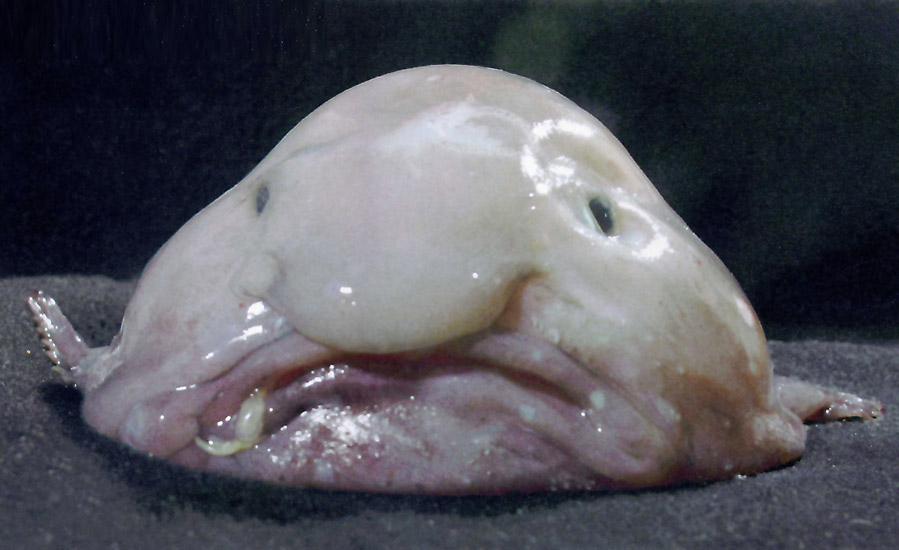
Amazing Sea Creatures..
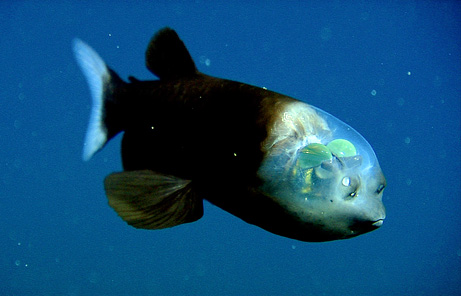
A fish with a transparent head
Here are some amazing once in a life time picture collection of sea creatures..Truly amazing..
The world's oceans cover two thirds of Earth's surface. There are many animal species virtually unheard of since the depth were they are located it makes it impossible for people to document them. The deep sea is about 78% of the planet's inhabitable volume, fascinating people all over the world about rare or unknown sea creatures.
Modern research has shown that, despite the pitch-blackness of the water, the freezing cold, and the crushing pressure, some amazing and bizarre creatures have adapted to life in the depths of the sea.
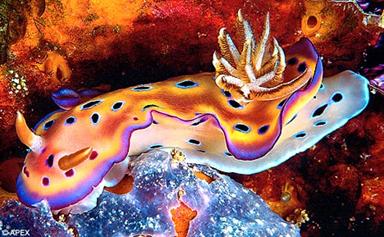
A real slugger: This Indonesian sea slug has exposed gills and sensory 'horns', acquiring vivid colours from reef life it devours
The world's oceans cover two thirds of Earth's surface. There are many animal species virtually unheard of since the depth were they are located it makes it impossible for people to document them. The deep sea is about 78% of the planet's inhabitable volume, fascinating people all over the world about rare or unknown sea creatures.
Modern research has shown that, despite the pitch-blackness of the water, the freezing cold, and the crushing pressure, some amazing and bizarre creatures have adapted to life in the depths of the sea.
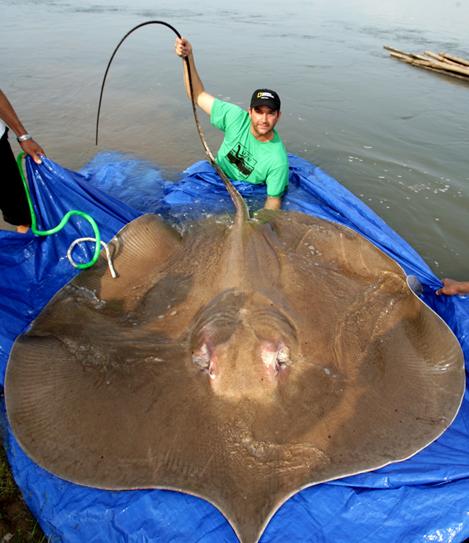
Not described by science until only 20 years ago, the giant stingray is believed to be the largest freshwater species in the world. The fellow above is about 13 feet in diameter and was photographed in Cambodia's Mekong River. It has been known to pull small boats along the river. I would imagine that the habitat of these amazing rays will be threatened as humans continue to exploit freshwater resources. You can read more about this creature below.
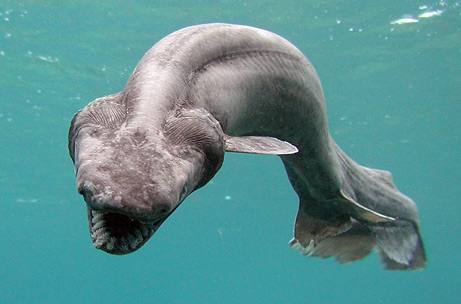
Somewhat rare, deep water "living fossil" with primitive morphology, such as a fixed upper jaw. The species reportedly feeds in caves or crevices and may have the longest known gestation period of any animal (3.5 years).
Photographed alive in Japan, January 2007.
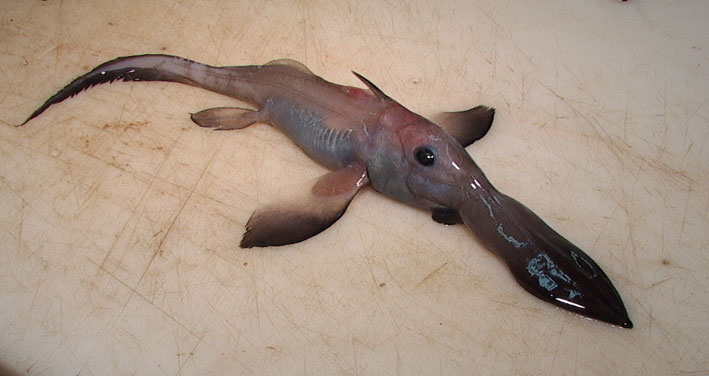
March 16, 2008 - Long-nosed chimaera (rhinochimaeridae) You probably remember the name from Greek mythology, Chimera is a fire-breathing female monster with a lion's head, a goat's body and a serpent's tail. Today, Chimera is a deep-ocean relative of sharks and ray, being often referred to as a ghost shark. Even though it is not as threatening as its fellow shark, the chimaera has a spine on the back that is highly toxic. A drop of venom can kill a man, but this case is highly unlikely since they live at depths of 8,000 feet.March 27, 2008 - Giant starfish from Antarctic waters
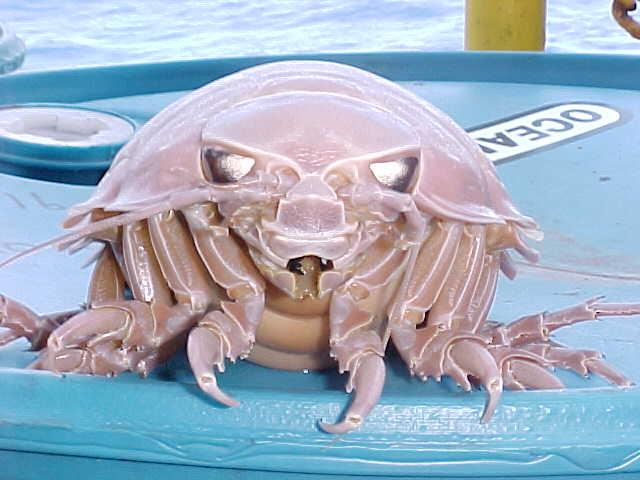
March 09, 2008 - Bathynomus giganteus-http://en.wikipedia.org/wiki/Bathynomus_giganteus
Another shark makes the list of the most peculiar sea animals. The Goblin shark is extremely rare, found only in deep water off Japan, South Africa, or Portugal. It has a very unusual snout, very pointed and flat. It is found in depths of about 3,940 feet (1,200 m) and believed to be harmless. Scientists think the snout's main purpose is to help the shark find food in deep, dark waters. There is little to be said about the shark since it has rarely been seen by humans and little data is recorded.
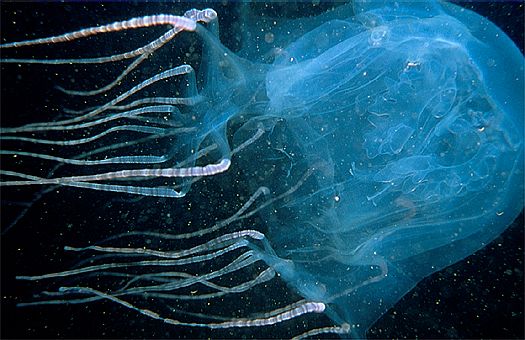
Described as one of the deadliest of all sea creatures, this type of jellyfish is famous for having an amazing defensive mechanism: it has 60 tentacles, with a length of up to 10 feet, packed with thousands of stinging cells that are activated when they touch the human skin. They deliver such an excruciating pain that the person attacked goes into shock and drowns. Their venom is considered to be among the most deadly in the world, containing toxins that attack the heart, nervous system, and skin cells.
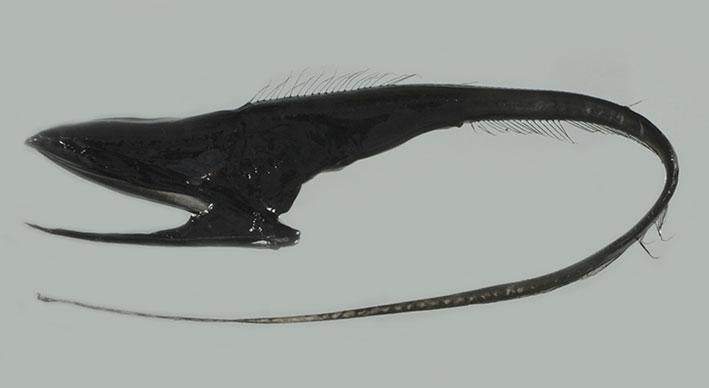
With a huge mouth and large tail used to catch its prey, this eel is one of the most bizarre looking creatures in the sea. Their wide jaws and elastic stomach make it possible for the eel to swallow fish bigger than them. They live at about 10,000 feet beneath the sea and can grow up to 80 cm in length. Usually found in all of the world's oceans at depths ranging from 3000 to 6000 feet, this eels have been brought to surface in fishing nets with their long tails tied into several knots.
This is the smallest sea horse in the world, reaching at maturity the size of a grain of rice. It is tiny, rarely reaching 15mm in length. There are very few things known about this seahorse, but scientists discovered that they eat the same zooplankton as the seafans that they inhabit. Still, seahorse numbers are diminishing, since they are used to treat sexual dysfunctions or consumed in Asia, roughly 45 tons of dried seahorses annually.
Probably more common than the rest of the other sea animals in the list, the tube-like creatures have a very important role in fighting the negative effects of global warming. It has been discovered that salps feed on the carbon-dioxide soaked algae from the oceans. Scientists that made this discovery are planning on increasing the algae-eating salp population in the world's oceans by boosting its food supply. According to their estimations, sequester nearly a third of manmade CO2 annually.
This fish has apparently been known for some time, but its unusual ability to rotate its eyes within its transparent head to look at objects above it was only recently reported in the journal Copeia in late 2008. This adaptation is likely due to the dark environment in which this fish lives. You can read more about this fish here.
Moscow’s New Arctic Policy Likely to Exacerbate Tensions in the Region
The Russian government's policy paper on Arctic policy, which was prepared last year, confirmed by President Dmitry Medvedev in September, but published only at the end of last week, sets the stage for intense competition between the Russian Federation and other Arctic powers as well as between the center and Russia's northern regions.
The 2900-word paper, now available on the website of the Russian security council (www.scrf.gov.ru/documents/98.html), outlines in broad-brush terms Moscow's interests, concerns, and goals in the Arctic for the next decade, but both its thrust and certain specific provisions point to problems ahead both internationally and domestically.
The reason for the delay in the publication of this document is unknown, but the reasons for its being posted online now seem clear: The Russian government is concerned about a Norwegian-led "Cold Response" military exercise and about Denmark's call for an international conference of Arctic powers (kommersant.ru/doc.aspx).
To the extent that is the case, the document has both diplomatic and propagandistic purposes and thus contains many bows to ecological concern and the need for cooperation of all parties. But three aspects of the paper point to possible tensions ahead both among these powers and within the Russian Federation.
First, the paper specifies that Moscow views the Arctic as "a strategic resource base of the Russian Federation, which will guarantee the resolution of the tasks of the social-economic development of the country." In short, the Russian government wants to exploit the oil and gas deposits on the seabed.
Given declining production in many Russian fields, a boost from production in this region would play a key role both in Russia's economic development and in its geopolitical approach, and given global warming, Moscow has particular interest in staking its claim to control of newly opening shipping lanes.
Second, while it contains the usual call for international cooperation and negotiation on all issues, the new policy paper makes clear that Moscow intends to have a strong military and security presence in the region in order to be able to press its claims to a very large swath of the extreme North.
On the one hand, the document says that the Russian government will create "groups of forces of general assignment of the Armed Forces of the Russian Federation, as well as other forces, military units and organs (in the first case the border organs) in the Arctic zone of the RF capable of guaranteeing military security in various military-political situations."
And on the other hand, the new policy paper says that Moscow plans to increase the role of the FSB in controlling the Arctic zone, even as it talks about using central Russian government funds to improve the standard of living in this enormous but thinly populated part of the country.
The first of these directions will exacerbate tensions with other Arctic powers. For a discussion of the different views of these powers on the Arctic and on the ways in which this could change the military balance in the Far North, see the discussion of these issues contained in an article posted last week at www.chaskor.ru/p.php.
But the second is likely to create some domestic problems, providing a government declaration that peoples in this region are certain to refer to as they press for more assistance and one that many in the region are likely to take as an indication that they will be subject to far more control by the security agencies than at any time since the Soviet period.
But just how far the Russian government will move to implement this policy paper is far from clear. Many times, Moscow has announced a policy and then not proceeded to take action. This time, however, the document in question suggests that Russia's future is on the line depending on what it does in the Arctic.
And that stress in turn suggests that the Russian government will take some of the steps indicated, especially in the security area, thereby lending support to headlines in Russian media on Friday and Saturday suggesting that a new "Cold War" is really beginning in one of the earth's already coldest places.
Tuesday, November 25, 2008
Fwd: CLIMATE CHANGE AFFECTING BEACHES
CLIMATE CHANGE AFFECTING BEACHES
Monday, November 24, 2008
But in the warming world of the 21st Century, waves could be riding oceans that will rise anywhere from 0.5 meters (19 inches) to 1.4 meters (55 inches), and researchers believe there's a good chance they will stir stronger feelings than melancholia.
Several scientists from Scripps Institution of Oceanography at UC San Diego are finding that sea level rise will have different consequences in different places but that they will be profound on virtually all coastlines. Land in some areas of the Atlantic and Gulf coasts of the United States will simply be underwater.
On the West Coast, with its different topography and different climate regimes, problems will likely play out differently. The scientists�?most recent conclusions, even when conservative scenarios are involved, suggest that coastal development, popular beaches, vital estuaries, and even California's supply of fresh water could be severely impacted by a combination of natural and human-made forces.
Scripps climate scientists often consider changes in average conditions over many years but, in this case, it's the extremes that have them worried. A global sea level rise that makes gentle summer surf lap at a beachgoer's knees rather than his or her ankles is one thing. But when coupled with energetic winter El Nino fueled storms and high tides, elevated water levels would have dramatic consequences.
The result could transform the appearance of the beaches at the heart of California's allure.
'As sea level goes up, some beaches are going to shrink,' said Scripps oceanographer Peter Bromirski. 'Some will probably disappear.'
Sea level has been trending upward for millennia. For the last 6,000 years, it is estimated that global sea levels have rising an average of five centimeters (2 inches) per century. Before that, between 18,000 and 6,000 years ago, the seas rose a full 120 meters (400 feet). Step by step, they bit into rocky coastlines like California's by smashing cliffs, creating beaches with the debris, rising a bit more, and repeating the process over and over again.
Humans are speeding up the pace of that assault. The United Nations sponsored Intergovernmental Panel on Climate Change (IPCC) reported that sea level rose, on average, 1.7 millimeters (0.07 inches) per year over the entire 20th Century. But recent estimates from satellite observations find a marked increase, at 3.1 millimeters (0.12 inches) per year since 1993.
The oceans are rising because the warming ocean water increases in volume and because water is being added from melting glaciers and land based ice sheets. The complex difficult to predict contribution of the latter is such a matter of controversy that the recent IPCC Fourth Assessment report didn't factor glacial melt into its sea level rise estimates. Today there is quite broad based opinion that the IPCC estimates are considerably lower than the higher range of possible sea level rise. Some individuals, pointing to the quantity of water frozen in Greenland and Antarctica and to ancient sea level evidence, have suggested that sea level rise could reach several meters by the end of the 21st Century. However, an August paper in the journal Science co authored by former Scripps postdoctoral researcher Shad O'Neel suggests that some of the more exaggerated claims that water could rise upwards of 10 meters (33 feet) by century's end are not in the realm of possibility. O'Neel and co authors indicate that the realities of physics impose a cap of 2 meters (6.6 feet) for possible sea level rise by 2100.
'That's fine,' said Scripps climate researcher Dan Cayan, who is leading an analysis of climate change scenarios for the state of California, 'but two meters is still enough to do a lot of damage.'
Recent news footage of overtopped levees makes it easy to envision what two meters' difference means to low lying cities like New Orleans, especially when extreme events like hurricanes are factored in. Any flooding would be proportionately higher than it is now. Additionally Bromirski recently showed that sea level rise will amplify the power and frequency of hurricane generated waves that reach shore, even if the storms themselves don't make landfall.
In contrast to the beaches of the East Coast, many of which are covered with vast expanses of sand, California's coastline is predominantly bedrock covered by a relatively thin veneer of sand. That sand can shift or disappear during storms. Thus, preserving the precious supply that keeps the tourists coming has for decades been a priority for state officials. Resource management, however, has required them to make trade offs. They have constructed seawalls to protect houses built on ocean cliffs. They have dammed rivers to create supplies of water for drinking and to prevent floods and debris from damaging downstream developments.
In so doing, nature's two primary sources of beach replenishment have been muted in a process known as passive erosion. Managers have compensated through artificial beach replenishment projects but at a costs that approach $10 per cubic yard. Since usually millions of cubic yards of sand need to be moved, there are monetary limits to what they can reasonably accomplish.
Reinhard Flick, who received his doctorate in oceanography from Scripps in 1978, needs only to look out his office window to watch the losing battle of beaches unfold. During his student days, he used to play volleyball on stretches of sand that are now underwater except during low tide. Rocks buried under several feet of sand four decades ago are now exposed for large parts of the year.
The staff oceanographer for the California Department of Boating and Waterways, Flick said that seawalls causing passive erosion will likely combine with sea level rise to doom some Southern California beaches. The change will become most apparent during El Nino events, when a pool of warm Pacific Ocean water settles off the coast for a year or two. El Nino has a dual effect on the West Coast. It not only feeds more intense storms but the warm ocean water itself causes a temporary spike in sea level that is above and beyond the rise that climate change is causing. During the 1997/98 El Nino, for instance, tide gauges off San Francisco recorded that sea level was 20 centimeters (8 inches) above normal for more than a year, including the winter storm season. That temporary rise is about equal to the rise observed for the entire 20th Century.
If sea levels rise substantially, when a large storm coincides with a high tide during an El Nino event, there could be widespread inundation along the California coast. Effects could range from a submersion of areas of San Diego's Mission Beach to an inundation of the Sacramento San Joaquin Delta. There, an overtopping of the delta's levees by brackish water could paralyze the main component of the state's water delivery system. Cayan noted that repairs to the system could take months.
The threat resonates with state officials, who have tasked Scripps and other institutions with creating and updating sea level rise scenarios.
'There's no clear path forward with sea level rise,' said Tony Brunello, deputy secretary for climate change and energy at the California Resources Agency, a key Scripps partner in developing the state's response to manifestations of global warming. 'You typically want to work with one number (but) what we want people to do is work with the whole range of estimates.'
Cayan and other Scripps researchers who are collaborating to study sea level rise emphasize that there remains a great deal of uncertainty in the creation of estimates for the coming century. The range of rise estimated by Cayan is based on scenarios of global air temperatures over the next 100 years, which range from about 2掳 C (3.6掳 F) to about 6掳 C (10掳 F). By 2100, global sea level rise reaching a half meter seems likely, and if the higher rates of potential warming occur it could rise by more than one meter. The potential cost of any government project or policy change puts a high premium on narrowing this range. As O'Neel and his co authors observed in their paper, the cost of raising Central Valley levees only 15 centimeters (6 inches) to prepare for higher sea levels has been estimated at more than $1 billion.
'These are very broad brush preliminary kinds of studies right now, but you have to start somewhere,' said Scripps coastal oceanographer Bob Guza.
Flick said it will be essential for scientists to be able to study the effects of the next El Ni帽o so they can begin to understand not just where damage will happen on the California coast but to what extent. He only had surveyor's equipment and aerial photos available to him to measure beach changes after the 1982/83 El Nino, but Guza and his collaborators now have light detection and ranging (LIDAR) and GPS technologies to make precise surveys of beach and cliff damage. Guza and Flick hope that Scripps can not only enhance its use of such technology but to deploy it within hours of a major storm event.
'We need to be geared up to quantify what beach changes are,' said Flick. 'We have to do an even better job of studying wave forces and wave climate.'
If there's any good news for Southern California, Scripps climate scientist Nick Graham has estimated that ocean warming trends will drive storm tracks farther north, perhaps sparing the state's lower half from the full brunt of buffeting El Nino waves the 21st Century will generate. Graham compared winds produced in three different simulations of climate change with those generated in the late 20th Century. The models showed that Southern California can expect a moderate decrease in wave size of about 0.25 meters (10 inches). But even there, Graham sees a problem.
'I'm a surfer. I think that's horrible,' he said.